A spreadsheet runs a core task
Quotes, inventory, scheduling or case tracking depend on a shared spreadsheet that only one or two people know how to keep up to date.



A tool built around the way you work.
When a spreadsheet, off-the-shelf software or poorly connected tools can’t keep up, a custom web application can take over. We start from your actual tasks, build the tool with proven web technologies chosen for the project, and hand over the code and its documentation.
Custom isn’t always the right answer. It makes sense when the way you work is an advantage that off-the-shelf tools can’t follow. Otherwise, well-configured existing software is often enough, and we’ll tell you so.
Quotes, inventory, scheduling or case tracking depend on a shared spreadsheet that only one or two people know how to keep up to date.
You pay for features you don’t use, and the team works around the missing ones with files and emails.
They email or call to check on an order, a file or a document that an online space could show them.
The same data is entered in several tools, and no existing connector handles your rules or exceptions.
Every engagement is scoped before we start. It can cover one or more of these areas.
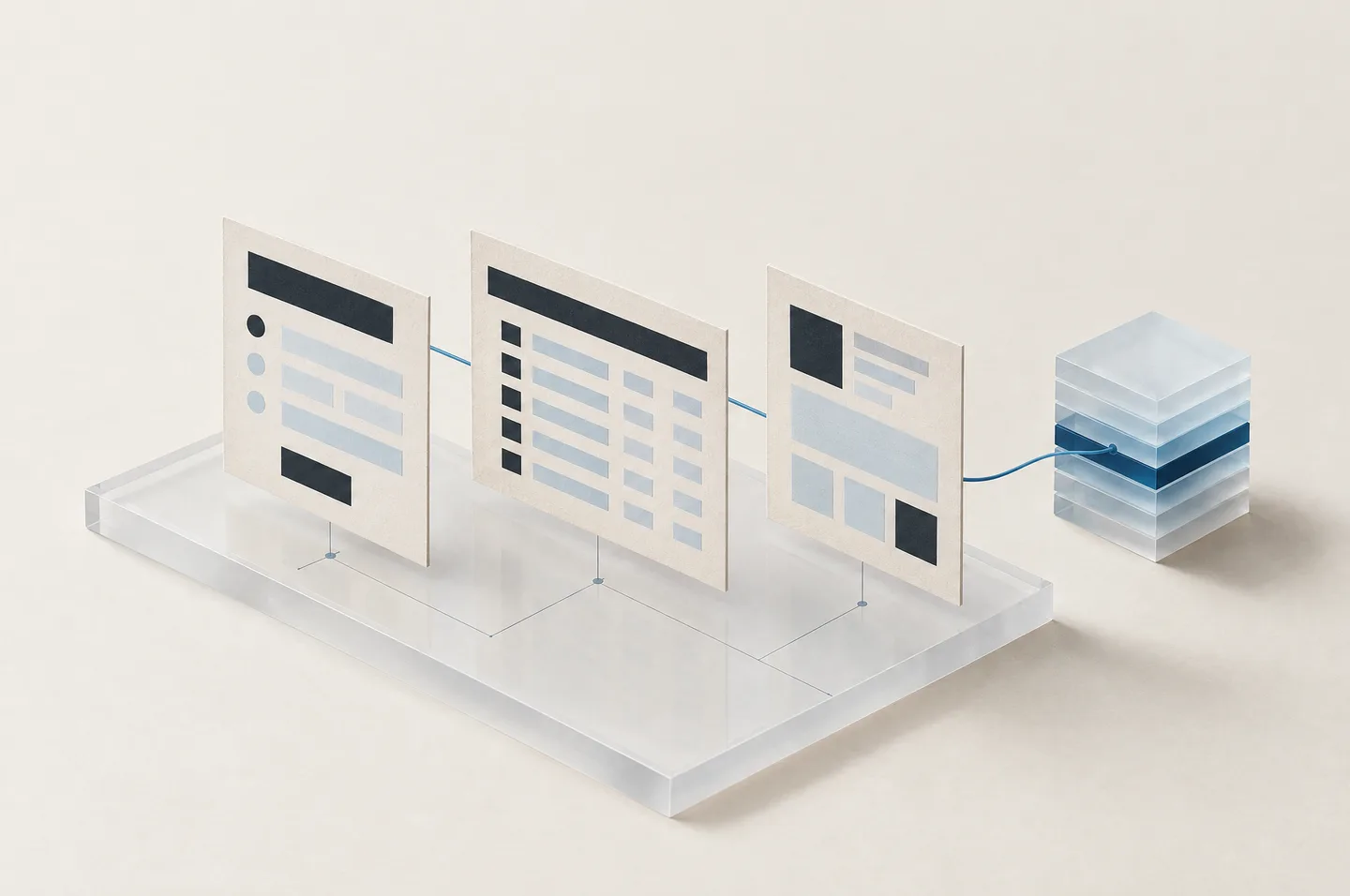
A business tool for your team: data entry, tracking, calculations and approvals that follow your rules, with accounts and role-based access. It runs in the browser, on a computer or a phone.
A secure space where your clients view their files, upload documents or follow a request, without going through email.
A sync between your tools when a connector or a simple API isn’t enough: business logic, data specific to your company, or a system without a suitable API.
Adding a feature to a tool we delivered, after an assessment. We can also offer hosting and maintenance for the application, separately and by agreement, in accounts in your company’s name.
An illustrative case, to show how a tool is built from an existing task.
Quotes are prepared in a shared spreadsheet: one row per client, copied formulas and versions sent by email.
Prices, approval steps and exceptions are described with the team that does the work.
A first version covers the most frequent task, with real test data. The team tries it before moving on.
Role-based accounts, change history and sending the quote to the client are added according to the agreed priorities.
Data is migrated, the team is trained and the spreadsheet stays available during the transition.
Illustrative example, not a completed engagement.
The software is delivered in stages: you try it early and adjust priorities along the way. How long it takes depends on the features chosen and your team’s availability for testing.
Look at the task as it’s done today, with the people who do it: data, rules, exceptions and tools in place. We also check whether existing software would do the job.
A proposal sets out the features of the first version, what comes next, the deliverables, the schedule, the price and any external costs.
Flows, main screens and the data structure are approved with you before development.
Each stage delivers a usable part, tested with your test data. The planned adjustments are set out in the proposal.
Data migration if the engagement includes it, team training, then handover of the code, access and documentation.
The exact list depends on the agreed engagement.
Tasks, rules, roles and exceptions described with your team, and the features chosen for each stage.
Flows and main screens approved before development.
A live version, with accounts and role-based access within the agreed scope.
Use cases and exceptions checked, observed result and fixes made.
Source code, dependencies and technical documentation handed over, so another provider can take the tool over.
Access in your company’s name, team training and what to do if something goes wrong.
We build applications that run in the browser, on a computer or a phone. Mobile apps installed from an app store are not part of the offer.
The features of each stage are set in the proposal. A new request along the way is estimated before it’s added.
Hosting, domain name, licences and third-party services are set out in the proposal, with who pays for them. Accounts are opened in your company’s name.
Hosting, maintenance and updates are offered separately, by agreement. Without an agreement, you keep the code and documentation to hand to whoever you choose.
The price mainly depends on the number of screens and roles, the rules to program, the integrations and the data to migrate. The proposal breaks it down by stage, with external costs, before you decide.
Off-the-shelf software fits when the way you work looks like the way it expects. Custom makes sense when your rules are specific to your company or the workarounds cost time every week. The first conversation is also there to check.
At the end of the engagement, you receive your application’s source code, its dependencies and its documentation, with a permanent licence to use it and have another provider change it. The reusable components we use from project to project are handed over as a copy for this application.
It depends on the features of the first version, the integrations and your team’s availability to approve each stage. The schedule is set out in the proposal; the first version is deliberately small, so it can be tried early.
Hosting, maintenance and updates can be offered separately, by agreement. Since the accounts are in your name and the code is handed over, you can also give them to your team or another provider.
These are the kinds of custom software projects we take on for small businesses in Quebec. Each one is scoped with you before work begins, and can be combined with others.
Internal web applications
Client portals
Custom integrations
After delivery
Pricing and choices
Tell us about the task the tool should take on, the tools you use today and the people who would use it. We’ll get back to you with next steps.